An ancient Taoist astrology tradition

Astrology Without
Horoscopes

Most astrology you'll encounter is horoscopic, planets along the ecliptic, twelve signs, rising degrees. That's a deep tradition, and not one I'm arguing against. But there is another way of reading the sky, just as old, that Western audiences have almost never heard of: Taoist natal astrology built around the celestial pole. The Northern Dipper rotating around Polaris, fixed stars above the ecliptic, the Seven Stars governing time and fate. This site is an attempt to present that tradition seriously, in English, for the first time.

Get foundational articles on the celestial pole tradition. Free, no spam.

About This Project

Polar Astrology

A Taoist astrology tradition that goes beyond horoscopic astrology

When Western astrology students think about the sky, the horoscope comes to mind first, planets moving along the ecliptic, the tradition that has defined astrology for millennia. But what if there is an astrology that sets the ecliptic aside entirely and looks instead to the fixed stars around the celestial pole? This is how certain Taoist and Chinese traditions have read the sky for just as long.

Polar Astrology, as I'm using the term, covers this tradition: the Northern and Southern Dippers' seasonal rotation, the cosmological roles of their stars, and the systems of time and direction built around the pole, the magnificence of Polaris and Canopus. It belongs to the same classical Taoist framework as the Five Elements, Heavenly Stems, and Earthly Branches, yet it has received almost no serious treatment in English.

While fragments have appeared under various names, Big Dipper astrology, Dipper star astrology, Beidou, Polar Astrology aims to present these ancient techniques as a complete and coherent system with the celestial and theoretical grounding they deserve for a Western audience.

I believe this knowledge belongs to humanity, not to any individual. Scholars, practitioners, and enthusiasts are encouraged to use this term freely, teach these concepts, and build upon this work. I only ask that you honor the tradition's roots and credit the sources that guide your understanding.

- Justin Y. North
Read the Forward →

What This Site Covers

Three areas of focus

The Classical Texts

Close readings of the sources that record this tradition, the Tiān Guān Shū, the Huainanzi, imperial astronomical records. What they actually say, not secondhand summaries.

The Seven Stars

The cosmological roles of each Dipper star, their Chinese names, their seasonal functions, and how the handle's rotation around Polaris structured time and direction in the classical system.

Articles

Specific questions worked through in full, how natal charts are cast from the pole, the relationship between Dipper timing and the Five Elements cycle, and case studies of historical figures examined against the tradition.

Now Available in Print

The Book

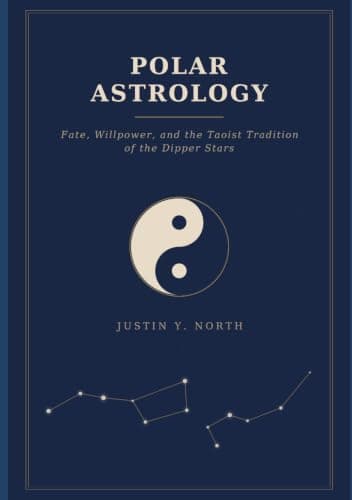
Polar Astrology, book cover

Polar Astrology

The book behind this project, covering the classical sources, the method of polar chart-casting, and case studies of historical figures. For readers who want the full argument rather than individual articles.

An Invitation

Join the Newsletter

Foundational articles on the celestial pole tradition, mundane astrology, and commentary on the classical Chinese cosmology, delivered to your inbox.

Free. No spam, unsubscribe anytime.

"The Northern Dipper is the chariot of the Celestial Emperor. It revolves around the centre, visiting and regulating each of the four cardinal directions. It divides yin from yang, establishes the four seasons, equalises the five elements, and determines the calendar."

Shǐ Jì · Tiān Guān Shū